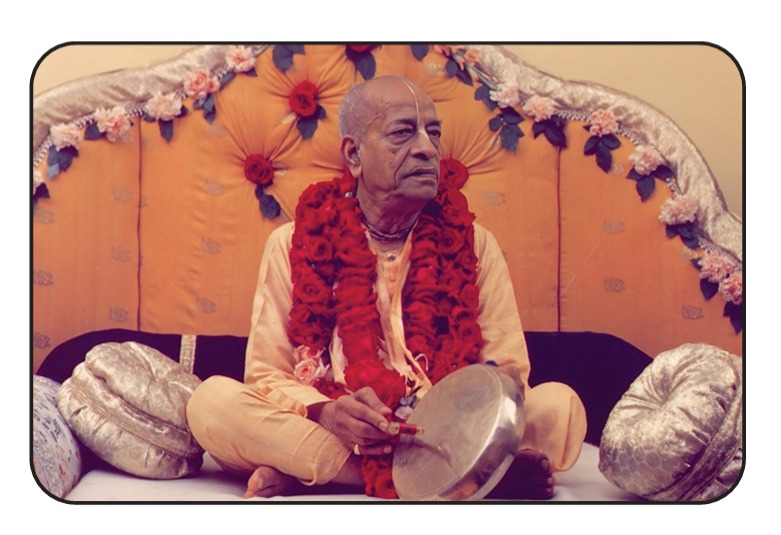
• Founder-Ācārya of ISKCON
His Divine Grace
A.C. Bhaktivedānta Swāmī Prabhupāda
A Brief Life Sketch
His Divine Grace Śrī Śrīmad A.C. Bhaktivedānta Swāmī Prabhupāda appeared in this world in 1896, in Calcutta, India. From his very childhood, he showed signs of deep spiritual inclination and an extraordinary intellect.
In 1922, he first met his spiritual master, Śrīla Bhaktisiddhānta Sarasvatī Gosvāmī Ṭhākura — a renowned philosopher, powerful preacher, scholarly devotee, ācārya, and the founder of sixty-four Gauḍīya Maṭhas. This learned young man immediately attracted Śrīla Bhaktisiddhānta, who urged him to dedicate his life to spreading Vedic knowledge in the English language.
Śrīla Prabhupāda accepted him as his master and, eleven years later, in 1933 at Prayāga (Allahabad), he became his formally initiated disciple.
From the very first meeting in 1922, Śrīla Bhaktisiddhānta Sarasvatī Ṭhākura had requested Śrīla Prabhupāda to preach Vedic knowledge through the medium of English. In the years that followed, Śrīla Prabhupāda began writing a commentary on the Śrīmad-Bhagavad-gītā, assisting in the work of the Gauḍīya Maṭha.
In 1944, he single-handedly began publishing an English fortnightly magazine. He himself typed the manuscripts, edited, proofread, and arranged for printing, even distributing the copies personally. Though at times he distributed them freely, he never allowed the publication to stop. That magazine, once begun, has never ceased — today it is being published by his disciples in more than thirty languages worldwide.
Recognizing his profound philosophical knowledge and devotion, the Gauḍīya Vaiṣṇava Society honored him in 1949 with the title “Bhaktivedānta.”
In 1950, Śrīla Prabhupāda retired from household life, accepting vānaprastha, in order to devote more time to his study and writing. Thereafter, he journeyed to Śrī Vṛndāvana-dhāma, where, under very humble circumstances, he resided in the historic Śrī Rādhā-Dāmodara Mandira.
For many years he absorbed himself in deep study and prolific writing. In 1959, he accepted the renounced order of life, sannyāsa. At the Rādhā-Dāmodara Mandira, he began what would become the most important work of his life: the translation and commentary of the Śrīmad-Bhāgavatam, the great Purāṇa of eighteen thousand verses, which he intended to publish in multiple volumes. It was here also that he composed his booklet “Easy Journey to Other Planets.”
After publishing the first three volumes of the Śrīmad-Bhāgavatam, in September 1965 Śrīla Prabhupāda traveled to the United States of America to fulfill the instruction of his spiritual master. When he first arrived in New York City aboard a cargo ship, he had not a single cent.
After a year of immense struggle, in July 1966 he formally established the International Society for Kṛṣṇa Consciousness (ISKCON). By the time of his disappearance on 14 November 1977 at the Śrī Śrī Kṛṣṇa-Balarāma Mandira in Śrī Vṛndāvana-dhāma, Śrīla Prabhupāda had, through his expert guidance, expanded ISKCON into a worldwide federation of more than one hundred āśramas, schools, temples, institutes, and farm communities.
In 1968, as an experiment in developing a Vedic society, Śrīla Prabhupāda established New Vṛndāvana in the hills of West Virginia. Inspired by the flourishing two-thousand-acre farm community there, his disciples went on to establish many similar communities throughout the United States and around the world.
In 1972, Śrīla Prabhupāda introduced the Vedic system of primary and secondary education in the Western world by establishing a gurukula school in Dallas, Texas. Since then, under his direction, his disciples have opened more than a dozen gurukulas worldwide, of which the Bhaktivedānta Swāmī Gurukula in Śrī Vṛndāvana-dhāma is the foremost.
Śrīla Prabhupāda also inspired the construction of magnificent centers at Śrīdhāma Māyāpura, Śrī Vṛndāvana-dhāma, and Mumbai — providing Western people with an opportunity to directly experience Vedic culture in its original setting. Projects for temples of Lord Kṛṣṇa are underway in twelve other important locations across India.
Yet, Śrīla Prabhupāda’s greatest contribution is undoubtedly his books. Scholars universally regard them as authoritative, profound, and clear, and they are used as standard texts in many universities. His writings have been translated into more than fifty languages.
In 1972, he established the Bhaktivedānta Book Trust (BBT) exclusively for the publication of his works. Today it is the world’s largest publisher in the field of Indian religion and philosophy. Altogether, he presented more than sixty priceless volumes — authentic translations, commentaries, and concise studies — of India’s greatest philosophical and devotional works. Some of his most celebrated works include:
- Bhagavad-gītā As It Is
- Śrīmad-Bhāgavatam (multi-volume translation & commentary)
- Śrī Caitanya-caritāmṛta (17 volumes, completed in 18 months)
- The Nectar of Devotion
- Kṛṣṇa, The Supreme Personality of Godhead
- Easy Journey to Other Planets
In just twelve years, disregarding the limitations of advanced age, Śrīla Prabhupāda circled the globe fourteen times as a traveling preacher. Despite his rigorous schedule, his prolific writing continued without interruption. His works together form a veritable library of Vedic philosophy, religion, literature, and culture.
By the time of his disappearance in 1977, he had transformed the lives of countless souls across the world, giving them the priceless gift of Kṛṣṇa consciousness. His mission, his books, his temples, and his disciples continue to carry the torch of Vedic wisdom to every corner of the world.
Śrīla Prabhupāda’s life and legacy stand as an eternal testimony to the power of pure devotion, selfless service, and unwavering surrender to the lotus feet of Śrī Kṛṣṇa.
“Our mission is to remind every human being that he is the eternal servant of God, or Kṛṣṇa. This is the sum and substance of the Kṛṣṇa consciousness movement.”
— Śrīla Prabhupāda